
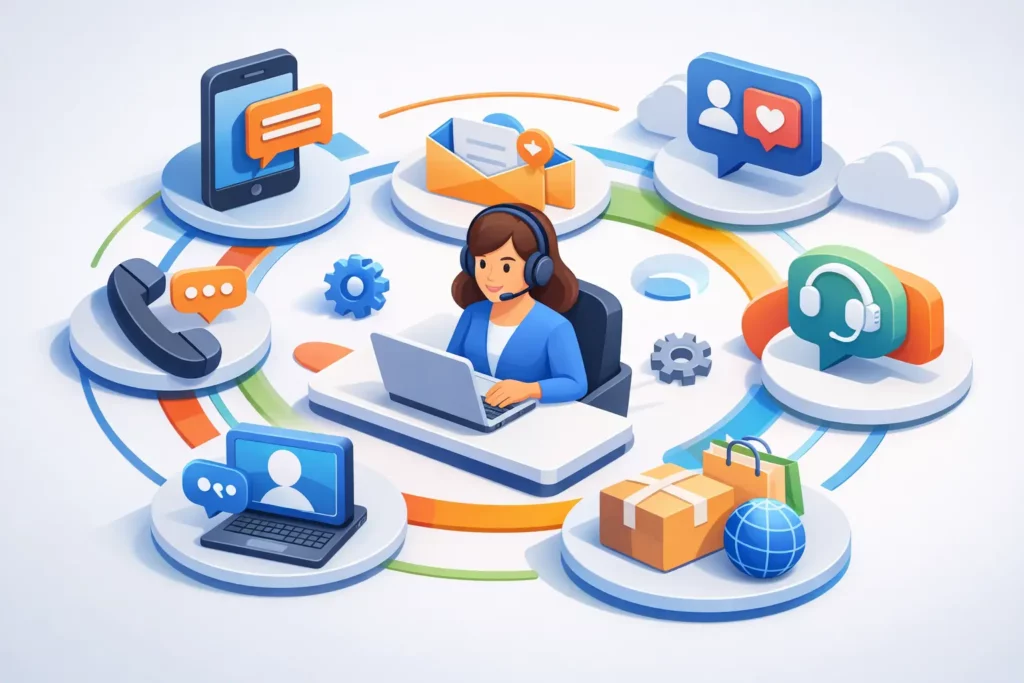
A customer sends an email in the morning, calls at lunchtime and gets in touch via chat in the evening. If your team then has to start from scratch each time, that’s not multichannel customer service – it’s simply running different channels in parallel. This is precisely where the question arises: how does multichannel customer service work in practice in a way that improves availability, efficiency and service quality all at the same time?
How does multichannel customer service work at its core?
Multichannel customer service means that companies support their customers via multiple communication channels – typically telephone, email, chat, contact forms, social media or messaging services. The key point, however, is not the number of channels, but how they are managed operationally. Only when enquiries are systematically recorded, prioritised, documented and assigned to the right team or process can a robust service model be established.
For businesses, this is primarily a matter of organisation. Each channel comes with its own set of expectations. On the phone, it’s all about being available and how the conversation is handled. With emails, response time and traceability are crucial. In chat, customers expect immediate replies, whilst in the back office, thorough follow-up, data maintenance and ticket processing make all the difference. Multichannel customer service therefore only works if the front office and back office work together seamlessly.
In a professional setup, all touchpoints are consolidated within a central service architecture. This does not necessarily mean that every system has to be identical. However, it does mean that information can be utilised across all channels and that staff can quickly grasp the customer’s context. In this way, individual contact channels are transformed into a managed customer dialogue.
The operational logic behind multi-channel approaches
In many companies, the range of communication channels is gradually expanding. First there is a helpline, then a general email address, later a chat service and perhaps even a bot for standard enquiries. This may sound customer-friendly, but it quickly leads to friction internally. Enquiries end up being duplicated in the system, responsibilities are unclear and priorities are handled differently depending on the channel.
For multichannel customer service to work, a clear operational approach is therefore required. The first building block is the function of each channel. Not every channel needs to do everything. The telephone is suitable for consultation-heavy, emotional or urgent enquiries. Email is ideal for cases requiring documentation. Chat is useful for quick queries, status updates or sales support. Automated workflows help with recurring processes such as appointment confirmations, pre-qualification or standard information.
The second component is routing. Enquiries must be directed to the appropriate department based on subject, urgency, language, availability or customer status. A VIP customer with a fault requires a different process to a simple change of address. Clear segmentation in this area reduces waiting times and improves the first-call resolution rate.
The third key element is transparency. Decision-makers need reliable data on how many enquiries are received via which channels, where bottlenecks arise, and which service levels are actually being met. Without this insight, a multichannel approach often remains a sound concept but one that is poorly managed.
What role do people, automation and AI play?
A common misconception is the assumption that multichannel is primarily a technical issue. Technology is important, but it is no substitute for service expertise. Human interaction remains crucial, particularly when dealing with complex enquiries, complaints or sensitive customer situations. The role of technology is to take the pressure off where it is needed most.
Automation is particularly useful where enquiries are standardised, frequent and clearly structured. This includes identification, categorisation, forwarding enquiries, or providing simple answers to recurring questions. AI can provide additional support by pre-sorting enquiries, suggesting responses, recognising tone of voice, or making knowledge bases more readily accessible.
It’s all about how everything works together. When a bot handles simple enquiries efficiently, service centre staff have more time to deal with more complex cases. If conversation data from phone calls, emails and chat is visible in one central place, an agent can take over the case more quickly. If a back-office task is triggered automatically following a contact, the administrative workload is reduced.
However, there are limits. Too much automation can frustrate customers, particularly when they get stuck in rigid processes whilst trying to resolve a specific issue. Companies should therefore not ask how much they can automate, but rather where automation has been shown to improve the service.
How does multichannel customer service work from an organisational perspective?
Technology alone does not guarantee service quality. In practice, it quickly becomes clear that multichannel customer service requires, above all, clearly defined roles, processes and responsibilities. Who handles which enquiries? What are the response times for each channel? When should an issue be escalated? What information needs to be documented? And how can we ensure that the brand image and tone remain consistent across all channels?
For many companies, this is precisely the crux of the matter. Structures that have developed internally are often not designed for cross-channel management. The marketing department manages social media, the internal team replies to emails, the contact centre handles calls and the back office deals with special cases. From the customer’s perspective, this is a single brand. Internally, however, there are several silos.
A professional multichannel model does not completely eliminate this separation, but it does bridge the gap. This is achieved through defined service processes, a shared database, clear escalation procedures and consistent quality assurance. Training plays a major role in this. Staff must not only be able to operate the systems, but also communicate appropriately for each channel. A good telephone service does not necessarily make for a good chat service – and vice versa.
Flexibility is also essential, particularly when volumes fluctuate. Seasonal peaks, Campaigns, delivery delays or disruptions can quickly lead to a sharp rise in the volume of enquiries. If only one channel can be scaled up in such cases, the pressure shifts to other contact channels. A resilient model takes such peaks in demand into account.
Typical benefits – and where companies get it wrong
When implemented correctly, multichannel customer service offers clear advantages. Accessibility increases because customers can choose the channel that best suits their situation. Service quality improves when information is consolidated and enquiries are routed more quickly to the right department. At the same time, resources can be managed more effectively because not every enquiry needs to be resolved over the phone.
This approach is also of interest from a sales perspective. Those who manage service contacts effectively can identify opportunities for upselling, cross-selling, customer retention or scheduling appointments at an earlier stage. This is particularly relevant in the B2B sector, as every point of contact also influences brand perception.
Nevertheless, a multichannel approach is not automatically more efficient. Additional channels initially mean greater complexity. If processes are not standardised, this creates duplication of work rather than reducing the workload. If service levels are not defined for each channel, this leads to disappointment rather than closer customer relationships. And if data is not properly consolidated, this results in a loss of overview rather than control.
It therefore depends on the objectives a company is pursuing. Is the primary aim to improve accessibility? To ease the workload on internal teams? To achieve growth without a proportional increase in staffing costs? Or to present the brand more professionally in customer interactions? The appropriate multichannel model will vary depending on the specific objectives.
When is it worth using an external service partner?
Not every company needs to set up a fully in-house multichannel customer service operation. For medium-sized companies and larger organisations in particular, an external partner often makes sense when service volumes fluctuate, new channels need to be introduced quickly, or internal teams need to focus on their core tasks.
A specialist partner brings operational experience, well-established processes and scalable resources to the table. This is particularly valuable for inbound customer service, overflow scenarios, outbound campaigns or back-office processes that are clearly structured but resource-intensive. At the same time, an external operation should never feel like a foreign entity. It is crucial that the partner understands your processes, represents your brand effectively and is technologically compatible.
For Swiss companies, there is another factor to consider: the quality of customer interactions is often closely linked to linguistic proficiency, reliability and cultural understanding. Those with high expectations regarding availability and brand image do not need a standard model, but rather a service-centred setup with clear performance metrics.
AP Dialog AG is positioning itself precisely on the basis of this approach: bespoke multichannel service concepts that combine human service expertise with intelligent automation whilst remaining operationally flexible.
How to get a business off to a good start
Anyone wishing to improve multichannel customer service should not start by trying to cover as many channels as possible, but rather by conducting an honest assessment of the current situation. What are the most common reasons for contact today? Where do waiting times, media breaks or duplicate processing occur? Which enquiries can be standardised, and which require personalised support? And which service levels make economic sense?
This is followed by the target architecture. It defines which channels perform which functions, how enquiries are routed, which systems provide data, and how quality is measured. Only then is it worth deciding on tools, automation and staffing.
It is also important to start small and in a controlled manner. A pilot scheme for an additional channel, a clearly defined service group or a Overflow solution During peak periods, this usually provides better insights than a complete overhaul carried out all at once. This allows processes to be fine-tuned without jeopardising day-to-day operations.
Ultimately, multichannel customer service doesn’t work well simply because every channel is open. It works when customers are quickly put through to the right person, information isn’t lost, and your company remains professionally accessible even under pressure. That is precisely where the business benefit lies – not in the channel itself, but in the quality of its management.
 Deutsch (Schweiz)
  Deutsch (Deutschland)
  Deutsch (Österreich)
  English (UK)